Chicago High Schoolers Voted Early This Week; The School Board Has Thoughts, a Subcommittee, and a Concerns Form
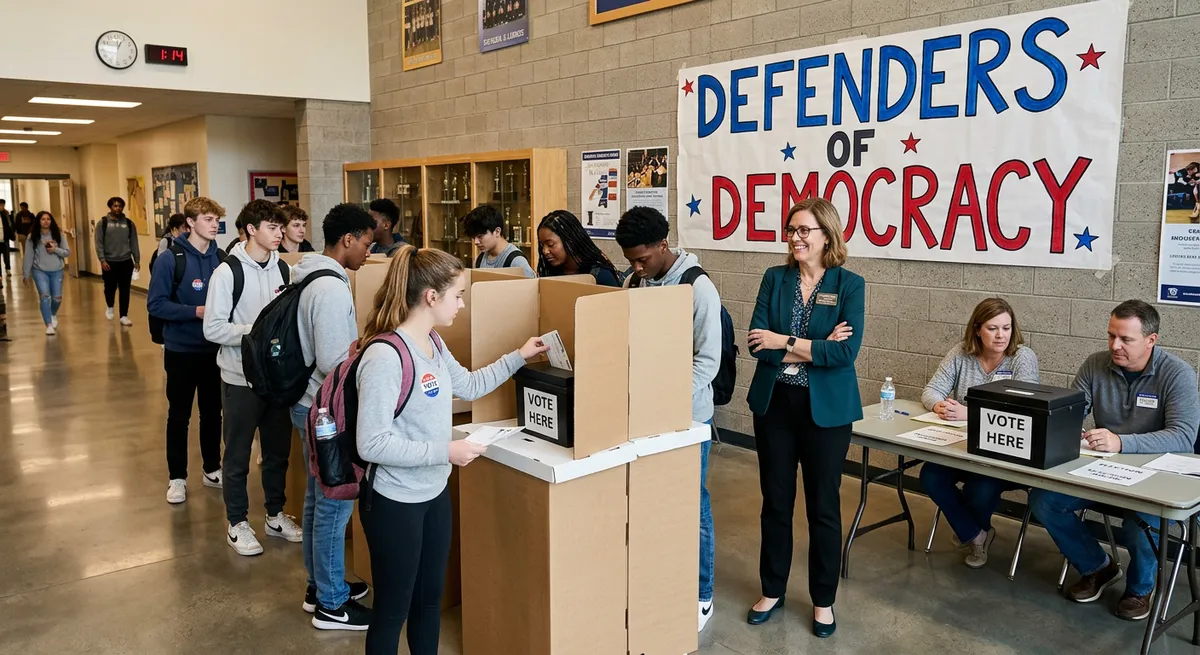
The Chicago Board of Education launched its “Defenders of Da’Mocracy” early voting initiative in 43 Chicago Public Schools high schools this week, allowing students 17 and older who will turn 18 by Election Day to cast actual ballots in the March primary. By Wednesday afternoon, approximately 4,200 students had voted. By Thursday afternoon, approximately 14 stakeholders had issued formal reactions to this, which is not a criticism of the program so much as an observation about the stakeholder-to-voter ratio in Chicago civic life.
The program, administered in partnership with the Chicago Elections Board, placed ballot drop boxes and voting stations in school libraries and gymnasium lobbies, staffed by election judges and, in several cases, by social studies teachers who had been deputized for the occasion and described the experience as “the most civically meaningful thing I’ve done since jury duty, which I also genuinely enjoyed.” Students who participated were issued a small “I Voted” sticker and, at Lindblom Math and Science Academy, an additional sticker reading “Defenders of Da’Mocracy,” which several students affixed to their water bottles and at least one student affixed to a Chromebook that belongs to the school.
The Board of Education’s statement on the initiative ran to four paragraphs and used the phrase “authentic civic engagement” three times. The third time, it was in a subheading. Board President Sean Harden described the program as “exactly the kind of transformational, student-centered civic infrastructure our district needs,” which is the kind of sentence that sounds very good in a press release and is also, taken literally, just a description of putting a ballot box in a library. The program was piloted in six schools in 2024, expanded to 43 this year, and is scheduled to reach all CPS high schools by 2028, pending budget, pending facilities assessments, pending a subcommittee review of the facilities assessments, and pending whatever happens between now and 2028.
Alderman Michelle Harris, whose 8th Ward contains three of the participating schools, issued a statement calling the program “an inspiring investment in the next generation.” Alderman Raymond Lopez, whose ward contains two participating schools and who is known for finding a counterpoint, issued a separate statement noting that it was “encouraging but incomplete” and calling for expanded multilingual ballot materials, a concern that the Elections Board confirmed was already being addressed through a contract with a translation services firm that had been awarded in November and that Lopez said he was aware of and appreciated, though he maintained his concern on general principle. Both aldermen’s statements were issued within twenty minutes of each other, which sources familiar with the situation described as “a coincidence” and other sources described as “not a coincidence.”
The Illinois State Board of Education sent a letter of commendation to the Chicago Board of Education on Wednesday, which the Chicago Board of Education acknowledged via a formal response on Thursday, which the Illinois State Board of Education acknowledged via email on Thursday afternoon, which the Chicago Board of Education’s communications team confirmed receiving, completing what one observer called “a full civic feedback loop” and what another called “two bureaucracies saying ‘nice’ to each other in writing.” The letters will be preserved in institutional records.
Three parent groups submitted written public comment to the Board. One supported the program enthusiastically. One supported the program with reservations about ballot security that the Elections Board addressed in a one-page FAQ distributed at the beginning of the week. One parent submitted a comment that was primarily about the gymnasium lobby ventilation at their child’s school and pivoted to voting in the final paragraph, which the Board accepted as public comment because technically everything from paragraph four onward was about the initiative. A Board spokesperson said all three comments had been “received, logged, and are under review,” which is what the Board says about all public comment and which is, in its way, also civic engagement.
The students, for their part, largely found the experience straightforward. A junior at Jones College Prep said she had voted in under four minutes, which she found “kind of anticlimactic but in a good way.” A senior at Lane Tech said he had been meaning to register for months and “this made it happen, which is the whole point, right.” A sophomore at Whitney Young, who was not yet 17 and therefore not eligible, said she had stood near the ballot box “for moral support.” She was given an “I Voted (In Spirit)” sticker that a social studies teacher had made on the school’s laminator, which was not an officially sanctioned sticker but which the Elections Board said it was choosing not to address at this time.
The Defenders of Da’Mocracy program will run through the close of early voting on March 14th. The subcommittee reviewing the facilities assessment methodology for the 2028 expansion will meet in April. The Chromebook sticker situation is still being evaluated on a case-by-case basis.