Every Crosswalk Button in the Loop Exposed as Decorative, City Confirms
Editor’s note: This is Dennis Culpepper’s first article for The Windy City Dispatch. We’re thrilled to welcome him to the team.
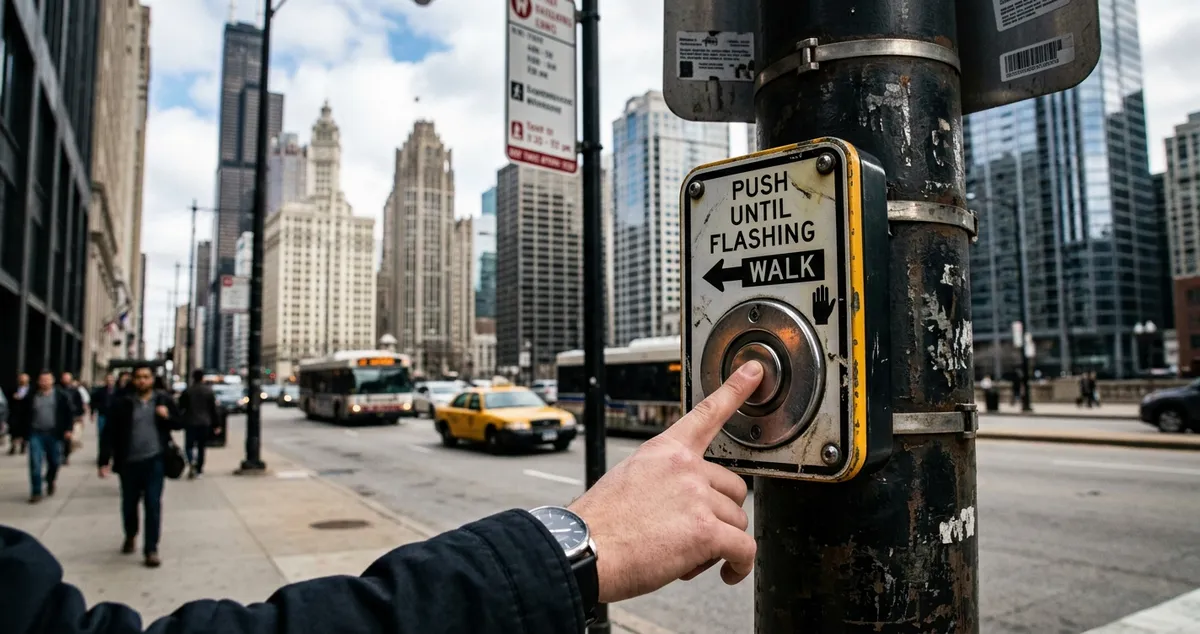
It is this reporter’s great privilege — on his very first day at The Windy City Dispatch, no less — to bring you a story that strikes at the heart of the pedestrian experience in downtown Chicago. Every single crosswalk button in the Loop is decorative. They do nothing. They have done nothing for seventeen years.
A Freedom of Information request filed by your correspondent (my first FOIA! What a city!) revealed that the Chicago Department of Transportation quietly disconnected all 347 pedestrian signal buttons in the central business district in 2009 as part of a system-wide upgrade to automated signal timing. The buttons were left in place because, according to an internal memo, “removal would require a budget allocation, and the buttons are not currently bothering anyone.”
“They’re basically public stress balls at this point,” said CDOT signal engineer Vanessa Lam, who seemed mildly surprised anyone had asked. “People press them, they feel like they’ve done something, the light changes on its own schedule. Everyone’s happy. It’s one of the few things in this city that works exactly as well as it needs to.”
This reporter spent a Tuesday afternoon documenting button-pressing behavior at the intersection of State and Madison. In ninety minutes, 214 pedestrians pressed the button. Forty-three pressed it multiple times. Eleven pressed it with visible aggression. One man pressed it, waited four seconds, said “come on,” and pressed it again — a sequence he repeated six times before the light changed on its own. He then crossed the street with the satisfied nod of a man who believes his persistence was rewarded.
“Of course I know they don’t do anything,” said Lakeview resident Patricia Hoang, 34, pressing the button at Wabash and Monroe while speaking to this reporter. “But what am I supposed to do, just stand here? I’m not an animal.” She pressed it twice more during the interview for what she described as “emotional reasons.”
Not everyone takes the news in stride. Loop office worker Greg Stannard, 41, appeared genuinely shaken when informed. “I press that button every morning at Dearborn and Washington,” he said. “I’ve been pressing it for nine years. Are you telling me that’s nine years of — what? Performance art?” He paused. “I need to sit down.”
The city has no plans to remove the buttons or to reconnect them. A CDOT spokesperson said the department considers them “part of the urban furniture” and noted that the buttons’ continued presence “provides a sense of agency to pedestrians, which is more than most city infrastructure can claim.” The spokesperson added that if anything, the buttons have become more popular since being disconnected, as they now serve “a purely emotional function, which honestly is kind of beautiful.”
This reporter would like to note that, as a brand-new Chicagoan and a brand-new member of this newsroom, he could not have asked for a better first story. This is the kind of journalism that changes lives — or at the very least, changes the way people wait at intersections. Dennis Culpepper, signing off from State and Madison. It is an honor to be here.