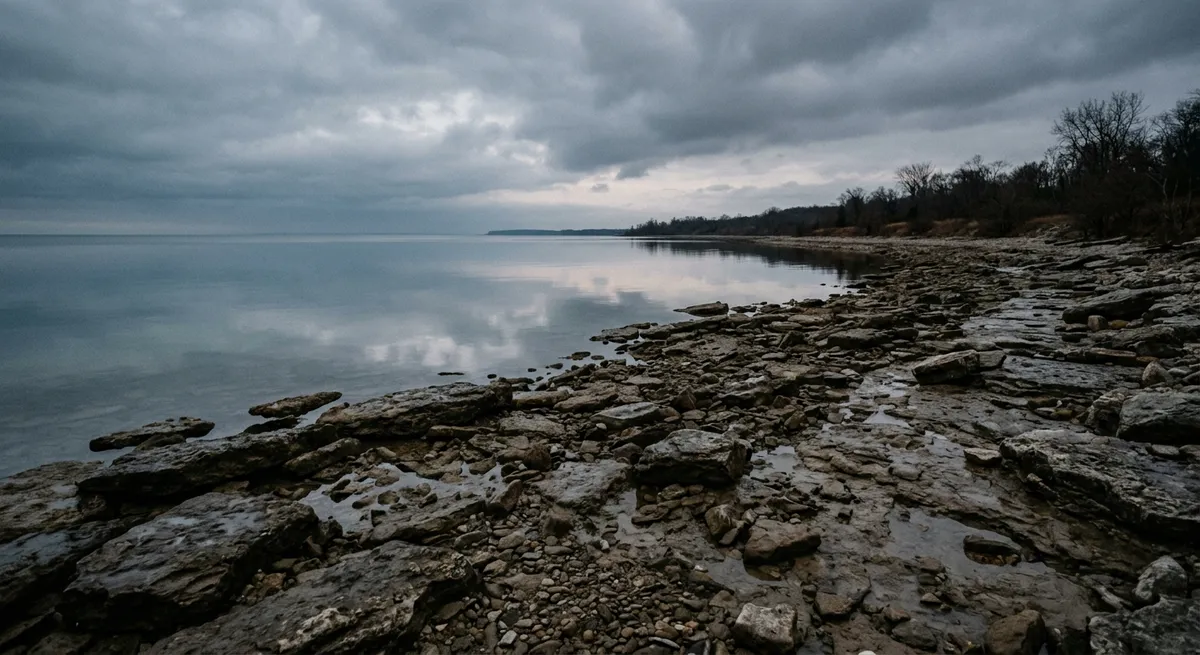
Lake Michigan Water Levels Drop Another 7 Inches as Lake Reportedly 'Going Through Something'
The numbers are straightforward enough. According to the U.S. Army Corps of Engineers, Lake Michigan’s water levels have dropped seven inches compared to the same period last year and are now seventeen inches below where they were two years ago. The seasonal patterns are well understood: levels typically rise in spring as snowmelt feeds the basin, then recede in late summer and fall as evaporation increases. The data is clean. The models are consistent. The lake, by all measurable accounts, is simply doing what lakes do.
And yet.
Something about the way Lake Michigan has been carrying itself lately has prompted a quiet but growing unease among the scientists who study it. The water is lower, yes. But it is also, in the words of one researcher, “different.”
“I don’t want to anthropomorphize a body of water,” said Dr. Lena Johansson, a limnologist at the University of Wisconsin-Milwaukee who has studied the Great Lakes for two decades. “But if I were going to anthropomorphize a body of water, I would say this one seems like it’s going through something.”
Dr. Johansson’s observations are not entirely metaphorical. Her team’s latest analysis of wave pattern data from monitoring buoys across the southern basin has revealed subtle but statistically significant changes in the lake’s behavior that do not correspond to any known climatic or hydrological variable. Wave intervals have become irregular. Surface temperature readings fluctuate in ways that don’t match wind patterns. And on two separate occasions in February, a monitoring station near Montrose Harbor recorded what Dr. Johansson described as “a long, low-frequency oscillation that, if it were a sound, you might describe as a sigh.”
“It wasn’t a seiche,” she clarified, referring to the standing wave phenomenon common in large enclosed bodies of water. “Seiches have a characteristic frequency. This was… slower. More deliberate. Like the lake was exhaling.”
The Army Corps of Engineers, which maintains the most comprehensive water level monitoring system on the Great Lakes, has not commented on the wave anomalies but confirmed the overall downward trend in levels. Spokesperson Major David Keller noted that fluctuations of this magnitude are “within the range of normal variability” and emphasized that the lake remains well above the record lows of 2013.
“Lake Michigan is a dynamic system,” Maj. Keller said. “It goes up. It comes down. That’s what it does.” When asked whether the lake seemed emotionally different to him, he paused for four seconds before saying, “I’m not going to answer that.”
For Chicagoans who walk the lakefront daily, the changes are subtle but noticeable. The beaches at North Avenue and Oak Street are fractionally wider than they were last spring. The rocks at Promontory Point in Hyde Park are more exposed. The waterline at the Riverwalk has crept back slightly, as though the lake is maintaining a polite but deliberate distance from the city.
“It used to come right up to the wall,” said Marion Voss, 73, a retired teacher who has walked the lakefront from the Museum Campus to Soldier Field every morning for thirty-one years. “Now it’s pulled back a little. It’s not dramatic. It’s like when someone scoots their chair away from you at dinner. You notice.”
Dr. Johansson says her team plans to deploy additional acoustic monitoring equipment along the shoreline this spring to better characterize the low-frequency oscillations. She is careful to note that there is, as yet, no scientific framework for describing a lake’s emotional state, and that her use of words like “withdrawn” and “sighing” are observational shorthand, not clinical diagnoses.
“I want to be clear,” she said. “I am not saying the lake is sad. I am saying that if you showed me this data without telling me it was a lake, and asked me how the subject was doing, I would say it seems like it needs some space.”
As of Tuesday morning, Lake Michigan’s surface was calm, gray, and very still—which could mean anything or nothing, depending on how much you’re willing to read into a body of water that holds 1,180 cubic miles of freshwater and has been here for roughly ten thousand years.
It has, in fairness, seen a lot.