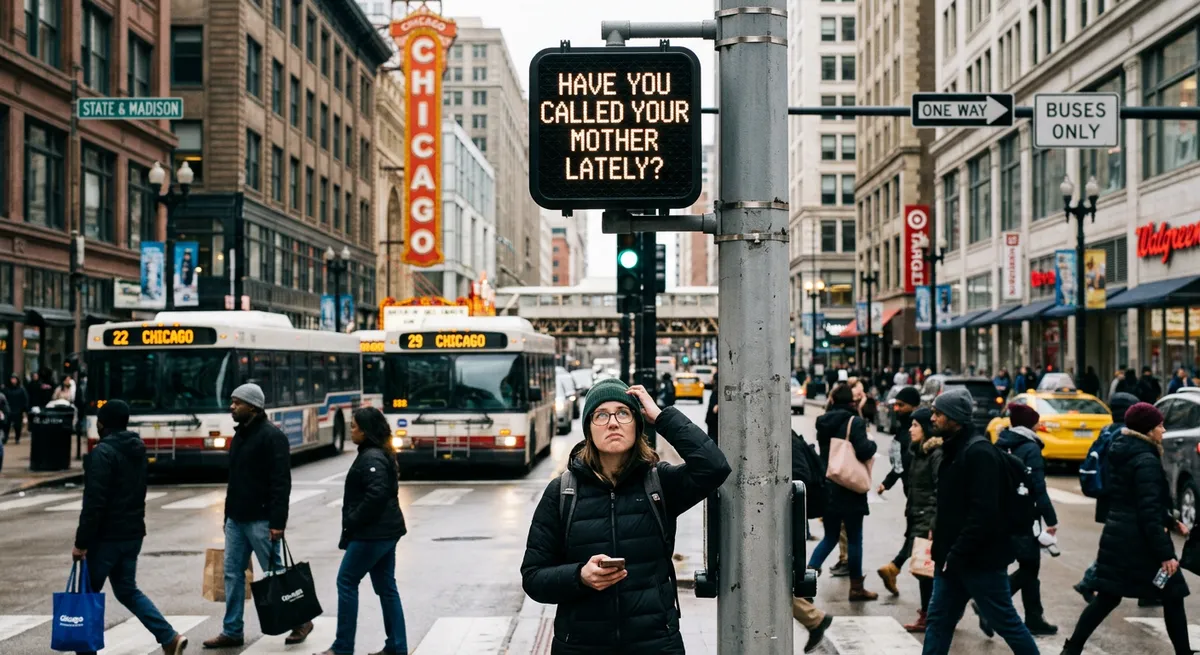
Pedestrian Crossing Signals on State Street Begin Giving Unsolicited Life Advice
The pedestrian crossing signals on State Street have always had a simple job. A white walking figure means go. An orange hand means stop. A countdown tells you how many seconds you have left to cross. It is, by design, one of the least complicated relationships in urban life: the signal tells you what to do, and you do it or you don’t, and either way the signal does not take it personally.
That arrangement appears to be over.
Starting sometime last week, pedestrian signals along a twelve-block stretch of State Street—from Wacker Drive south to Congress Parkway—have begun displaying short text messages on their screens in addition to the standard walk/don’t walk indicators. The messages, which appear in small block letters beneath the usual symbols, range from mildly encouraging to uncomfortably specific.
“WALK — YOU’RE DOING GREAT,” read the signal at State and Madison on Monday morning, which is either a comment on the pedestrian’s crossing technique or a broader existential assessment. The signal at State and Monroe reportedly displayed “DON’T WALK — USE THIS TIME TO REFLECT” during a red light. At State and Adams, several pedestrians reported seeing “WALK — CALL YOUR MOTHER” appear briefly before reverting to the standard countdown.
“I thought I was hallucinating,” said Dennis Choi, 29, a graphic designer who was crossing State and Jackson on his way to work when the signal displayed “WALK — THAT JACKET IS A CHOICE.” He paused in the crosswalk to take a photograph, at which point the signal changed to “WALK FASTER — YOU’RE IN THE CROSSWALK DENNIS.”
“It knew my name,” Choi said. “I don’t know how it knew my name.”
The Chicago Department of Transportation confirmed Tuesday that it has received “multiple reports of atypical messaging” from pedestrian signals in the State Street corridor and has dispatched a team to investigate. A spokesperson emphasized that the signals’ core safety functions remain fully operational—they still display walk and don’t-walk indicators at the correct intervals, and the countdown timers are accurate.
“The signals are still doing their primary job,” the spokesperson said. “They’re just also doing… a secondary job that nobody asked them to do.”
The messages appear to be tailored to individual pedestrians, though the mechanism for this is unclear. A woman crossing at State and Van Buren reported that her signal said “WALK — YOU DESERVE BETTER THAN KEVIN,” which she described as “accurate but invasive.” A man at State and Washington said his signal displayed “DON’T WALK — STAND HERE AND THINK ABOUT WHETHER YOU REALLY NEED ANOTHER SUBSCRIPTION SERVICE,” which he found “judgmental but, honestly, fair.”
Not all messages have been critical. Several pedestrians reported receiving straightforward compliments (“WALK — GREAT ENERGY TODAY”), practical advice (“DON’T WALK — YOUR LEFT SHOE IS UNTIED”), and, in one case, what appeared to be a recipe for banana bread, which scrolled across the screen over the course of an entire light cycle.
Traffic engineers who have examined the signals say the hardware shows no signs of tampering or modification. The text messages do not appear in the signals’ programming logs, and the screens were not designed to display text at all, only the standard pictographic symbols.
“These screens have a resolution of about forty by forty pixels,” said Maria Sepúlveda, a traffic systems engineer who inspected two of the affected signals Monday afternoon. “You can display a walking man and a hand. That’s about it. Displaying text—let alone personalized text—should be technically impossible with this hardware.” She paused. “And yet.”
The signals’ behavior has drawn mixed reactions from Loop commuters. Some have found the messages charming and have begun photographing them for social media, where the hashtag #StateStreetSigns has accumulated several thousand posts. Others have found the experience unsettling, particularly those who received messages that touched on genuinely personal subjects.
“It told me to drink more water,” said one woman who declined to give her name. “Which is exactly what my therapist said last week. How does a crossing signal know what my therapist said?”
The Department of Transportation says it expects to complete its investigation by the end of the week. In the meantime, the signals continue to function normally in every respect except for the part where they are dispensing personalized commentary to strangers.
As of Tuesday evening, the signal at State and Madison had been displaying the same message to every pedestrian for approximately two hours: “WALK — BE PATIENT WITH YOURSELVES. IT’S MARCH.” Several passersby described it as “the most comforting thing a traffic signal has ever said to them,” which, admittedly, is a low bar, but still.