White Sox Spring Training Averaging 3,056 Fans Per Game, Which Is Technically a Number Greater Than Zero
The Chicago White Sox spring training operation at Camelback Ranch in Glendale, Arizona is averaging 3,056 fans per game this season, according to figures released this week — a number that is, to be precise, a number, and one that exists at a meaningful remove from zero, which the organization characterized as encouraging. The Cubs, training 20 minutes away in Mesa, are averaging 11,207 per game. This gap — 8,151 people, per game, in a league where spring games don’t count — represents what data analysts describe as “a disparity” and what I would describe, after reading through the Sox’s recent communications, as “a thing no one at Camelback Ranch is eager to discuss in percentage terms.”
For context: 3,056 is more than the number of people who showed up to a mid-size regional conference I attended last March in a Marriott near the airport. It is fewer than the capacity of many high school football stadiums. In the hierarchy of “sports venues filled to some portion of their capacity,” Camelback Ranch currently sits at roughly 30%, assuming the park’s published capacity of around 10,000, which puts it in the range of “theater that maybe didn’t market the show well” rather than “spring training site for a professional Major League Baseball franchise.” The Sox’s internal communications team, reached for comment, said attendance figures “reflect a transitional moment for the organization” and that the club was “focused on the exciting young talent on the field.” Three follow-up questions were not answered.
The White Sox, as regular readers of this publication and anyone who has opened a sports page in the past eighteen months are aware, finished last season with a record that set a modern MLB benchmark for futility, a performance that the organization described at the time as “a learning experience” and that most people described using a different word. The rebuild — officially ongoing, featuring a roster of young players in various stages of development — is the context in which 3,056 spring training fans per game is either a reasonable starting point or a leading indicator, depending on which analyst you consult. I consulted four. Two said “reasonable starting point.” One said “deeply concerning.” One said “I mean, it’s spring training,” and then paused for a long time.
The Cubs’ 11,207 average is, of course, its own kind of data point. The Cubs signed Alex Bregman to a $175 million contract this winter, a move that generated significant coverage and fan engagement of the kind that translates, apparently, into people purchasing tickets to watch exhibition games in Arizona in February. The Sox have, in the same window, primarily generated coverage of their attendance figures, which is a different kind of publicity loop and one that is harder to monetize. A team executive I spoke with, who asked to remain anonymous because he has a boss, suggested that the Cubs’ spring attendance is “a different market” and that the Sox “compete on a different value proposition.” When I asked what that value proposition was specifically, he said it was “development” and “community” and “the kind of long-term thinking that doesn’t show up in single-season metrics.” I thanked him and noted that it also did not appear to be showing up in spring training tickets.
What is showing up, according to the Sox, is progress on the field — or at least, what the organization is characterizing as progress, which is a different thing but sometimes leads to the same place. The team’s young catchers have been described in multiple spring training dispatches as “exceeding expectations,” a phrase that, given recent expectations, operates on a fairly forgiving curve. The pitching staff, similarly, has received positive reviews in the context of “for where this team is right now,” which is its own specific genre of baseball optimism. These are genuine green shoots, or they are the kind of thing organizations say in March when they are trying to sell the feeling of spring training to people who, in 2026, are only 30% convinced.
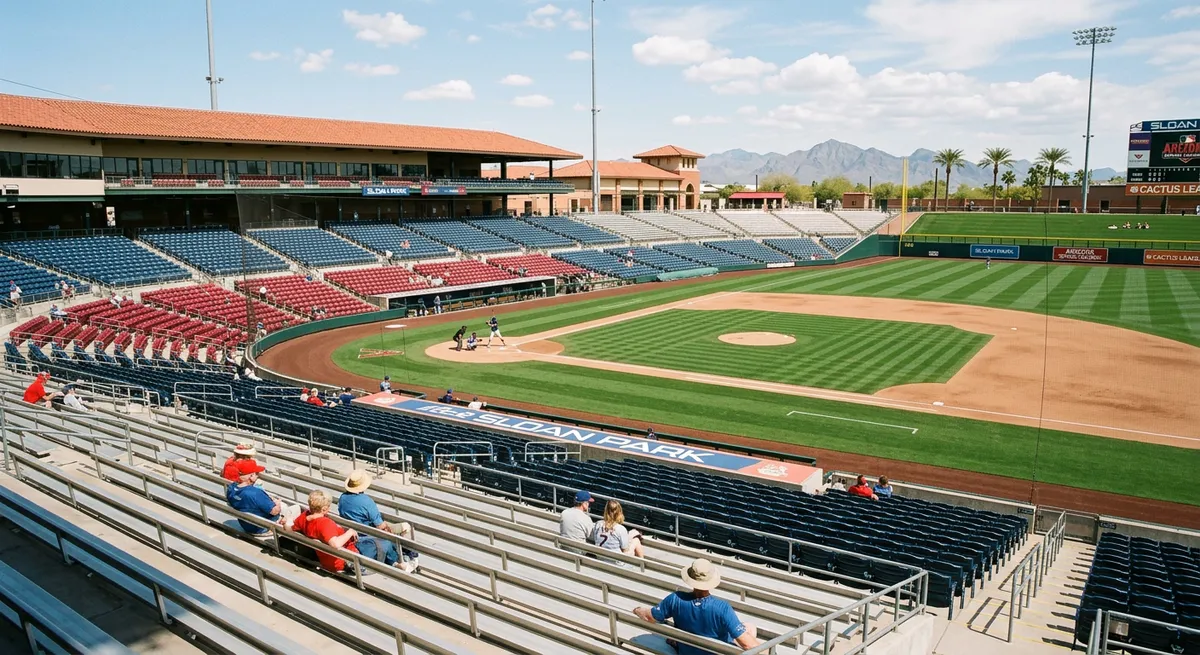
Meanwhile, Camelback Ranch itself — a perfectly fine baseball facility with excellent sightlines and sun — soldiers on as the stage for this particular drama. The concession stands are staffed. The field is manicured. The young Sox prospects take batting practice each morning in an Arizona sun that does not discriminate between teams averaging 3,056 and teams averaging 11,207. The gap in the stands is real, but the baseball is the same baseball. Whether those 3,056 people — whoever they are, whatever combination of South Siders, Cubs fans who wandered into the wrong ballpark, and Arizona retirees who just needed somewhere to sit — represent the floor of this organization’s fan engagement or the beginning of a floor is a question that will be answered over the next several months in a different ballpark, at a different temperature, by a team that has been told it is rebuilding and has, in its way, begun to believe it.
The Cubs declined to comment on the attendance gap, which is to say their communications team did not respond to my email, which is to say they are not interested in rubbing it in. This is generous of them. The White Sox said they were “grateful for the fans who have made the trip to Glendale.” All 3,056 of them, per game. Each one, presumably, very visible from the upper deck.