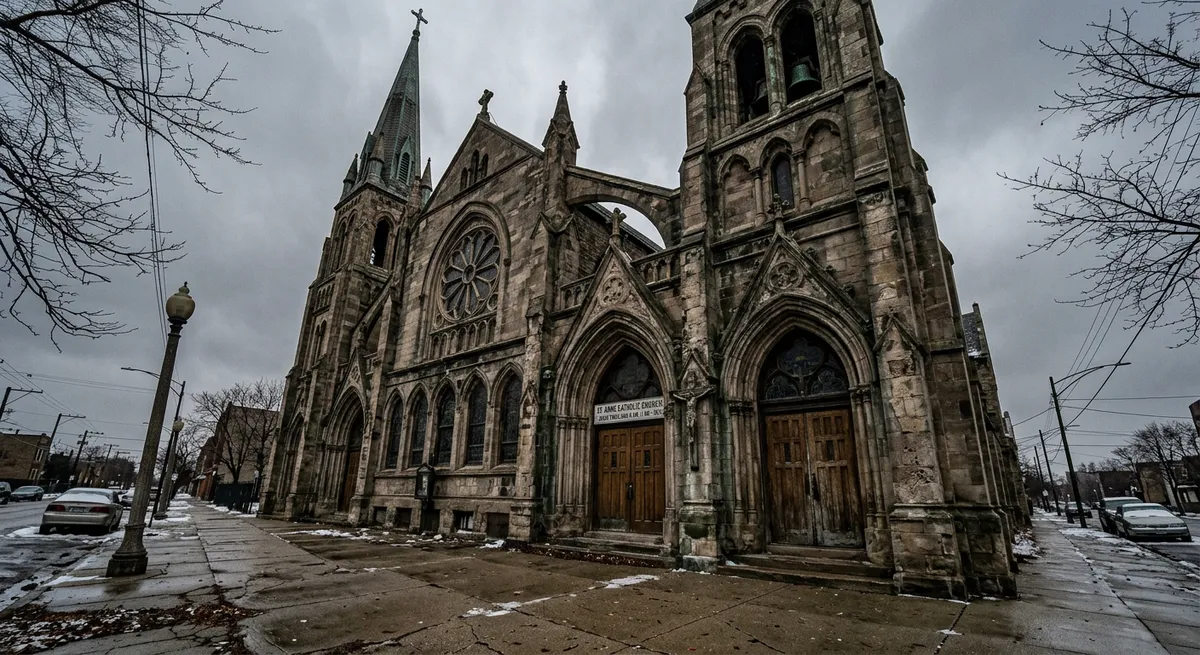
Pope Leo XIV's Childhood Church Makes Preservation Chicago's Endangered List; Vatican Described as 'Aware'
There is a particular kind of grief that belongs only to buildings — a slow, architectural sadness that accrues in the mortar, settles into the floorboards, and eventually announces itself to the world in the form of a Preservation Chicago report. This week, that grief was given a name: St. Mary of the Assumption, the South Side Roman Catholic parish on the city’s Southeast Side where Robert Francis Prevost spent his childhood Sundays before the world knew him as Pope Leo XIV, has been included in Preservation Chicago’s annual list of the city’s most endangered structures. The organization cited deteriorating masonry, deferred maintenance, and what its executive director described, with careful architectural precision, as “a building that is fighting very hard to remain standing.” The Vatican, reached for comment, issued a brief statement indicating it was “aware of the situation.”
I have walked past buildings that knew they were loved, and buildings that did not. St. Mary of the Assumption, when I visited it on a gray Tuesday morning, fell somewhere in between — a structure that once knew it was central to something, that had hosted first communions and funeral masses and an unknown number of ordinary Sundays for a boy who would one day be asked to lead 1.4 billion Catholics, and that now finds itself peering at its own name on a list of things that might not survive the year. The exterior limestone, once pale and certain, has taken on the exhausted quality of stone that has weathered too many Chicago winters without the structural intervention those winters demand. Several pilasters along the south wall have separated from the main facade in a way that Preservation Chicago’s report describes as “critical” and that I would describe, less technically, as the building asking for help.
The organization’s annual Chicagoland Watch list, released this week, identified seven structures across the metropolitan area whose continued existence is under meaningful threat. That the childhood parish of a sitting pope appeared on this list alongside two vacant commercial buildings and a 1920s bank lobby in Cicero has prompted a range of reactions across the city. Parishioners who grew up alongside the future pope described themselves as “heartbroken.” City preservationists described themselves as “not surprised.” The Archdiocese of Chicago issued a statement saying it was “committed to evaluating all available options,” which is a phrase that, in the dialect of institutional communication, means “we have not decided what to do and would prefer not to discuss it further at this time.”
What strikes me, standing on the sidewalk outside this particular building on this particular Tuesday, is the way sacred spaces age differently from secular ones — not better or worse, but differently, as though their relationship with time is mediated by the expectations placed upon them. A former factory can become a loft, a former bank can become a restaurant, a former warehouse can become forty-seven luxury apartments with exposed brick and a rooftop deck. A former church — a church that is still, technically, a church, still home to a small and dedicated congregation that has watched its neighborhood transform around it — cannot so easily be reimagined. It carries its purpose in its bones. The pointed arches, the nave, the orientation toward the east: these are not decorative choices. They are arguments about the nature of things, encoded in stone, now slowly separating from the wall.
Preservation Chicago has proposed a multi-stakeholder preservation initiative that would involve the Archdiocese, the City of Chicago’s Landmarks Commission, the National Trust for Historic Preservation, and what the report calls “the broader community of stakeholders with an interest in the site’s continued existence.” Given recent events in St. Peter’s Square, this community now extends, at minimum, to Rome. Whether that interest translates into scaffolding and restored limestone is a different question, one that the city’s preservation community is watching with the particular alertness of people who have seen this story before. Chicago has lost remarkable buildings to neglect. It has also, occasionally, saved them. The mechanism for the latter is usually some combination of money, political will, and someone making enough noise that it becomes easier to fix the building than to keep explaining why you haven’t.
The Chicago Stock Exchange Trading Room at the Art Institute of Chicago — the other high-profile inclusion on this year’s list — presents a different but structurally adjacent set of concerns: a landmarked interior space whose long-term stewardship arrangement with the museum has, according to Preservation Chicago, become “increasingly uncertain.” The juxtaposition of these two spaces on the same list — a trading room built for commerce, a nave built for transcendence — is the kind of civic coincidence that the city offers regularly to those willing to pay attention to it. Both spaces were built for a particular kind of human gathering. Both spaces are now in danger of no longer gathering anything at all.
The Preservation Chicago report will be formally presented to the City Council’s Committee on Zoning, Landmarks, and Building Standards next month. In the meantime, the limestone at St. Mary of the Assumption continues its slow negotiation with gravity, a negotiation that, like most negotiations in this city, is taking longer than anyone expected and has no guaranteed outcome. The building stands. It waits. The mortar, in its patient way, considers its options. The Vatican is aware of the situation.