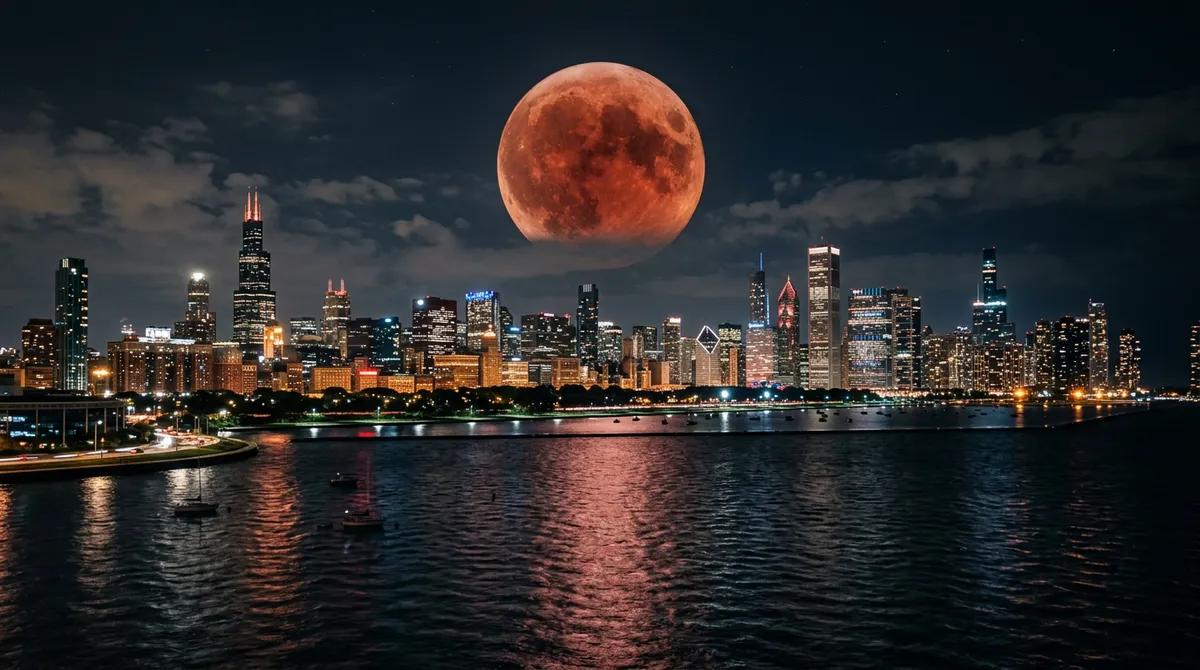
Moon Apologizes to Chicago for 'Unscheduled Darkening' Tuesday Morning
The Moon, which has been illuminating Chicago more or less reliably since the city’s incorporation in 1837, issued what sources close to the situation are describing as a “deeply heartfelt” public apology Tuesday morning after allowing itself to be entirely eclipsed for approximately 65 minutes without any advance notice to residents who had specifically gotten up early to see it at its best.
“I want to be clear that this was not intentional,” the Moon said in a statement released just before dawn, hovering approximately 238,000 miles above Lake Shore Drive at the time. “I had every intention of being fully present for Chicago this morning. The Earth got in the way. The Earth gets in the way sometimes. I am working on setting clearer boundaries with the Earth.”
The Moon had reportedly spent the better part of February preparing for its close approach, practicing what it described as its “full, luminous presentation” over Lake Michigan. It had been particularly proud of its reflection on the water near Montrose Beach, which it had been working on since November. The eclipse, which began at approximately 2:26 a.m. and reached totality at 5:26 a.m., turned the Moon a deep reddish-orange — a color the Moon acknowledged was “striking” but clarified was “not the look I was going for.”
“I wanted silver,” it said. “Crisp, authoritative silver. What Chicago got was rusty. I understand if people are disappointed.”
Several lakefront regulars who had set alarms and dragged folding chairs to the Adler Planetarium campus reported mixed feelings. “I mean, it was beautiful,” said one runner who asked not to be named but had clearly been awake since 4 a.m. and was wearing three jackets. “But I could tell it was embarrassed. The color was too red. Like it had been caught doing something.” The Moon, reached for comment on this characterization, said it appreciated the understanding but maintains it has never been “caught” doing anything and would prefer that framing be retired.
The Moon noted in its statement that lunar eclipses of this magnitude over the Chicago area are rare, occurring only a handful of times per century in conditions clear enough to observe. It expressed gratitude that cloud cover, which the Moon described as “historically my biggest critic,” had stayed away Tuesday morning, allowing residents an unobstructed if slightly humiliating view. “The clouds could have covered the whole thing and no one would have known,” the Moon said. “They chose not to. That was a grace I did not deserve, and I am grateful.”
NASA confirmed the eclipse was a routine astronomical event caused by the Earth passing between the Sun and the Moon, a phenomenon that has nothing to do with feelings. The Moon disputed this characterization. “NASA says a lot of things,” the Moon said.
Lake Michigan, which had spent the hours before dawn patiently reflecting whatever the Moon presented to it, declined to comment on the incident, which longtime observers interpreted as a sign of quiet solidarity. The Chicago skyline, which had been visibly pink in the Moon’s reflected reddish glow for most of the early morning hours, said through a spokesperson that it had “no complaints” and called the lighting “honestly kind of flattering.” The Moon said it would try to do better on September 11, 2026, when the next notable lunar event is scheduled, and asked that residents simply “give it a chance to be silver again.”
“I know I let Chicago down,” the Moon said. “Chicago is a city that looks up. It deserves a moon that is ready when it does. I will be ready. I have four months. I am not going to waste them.”