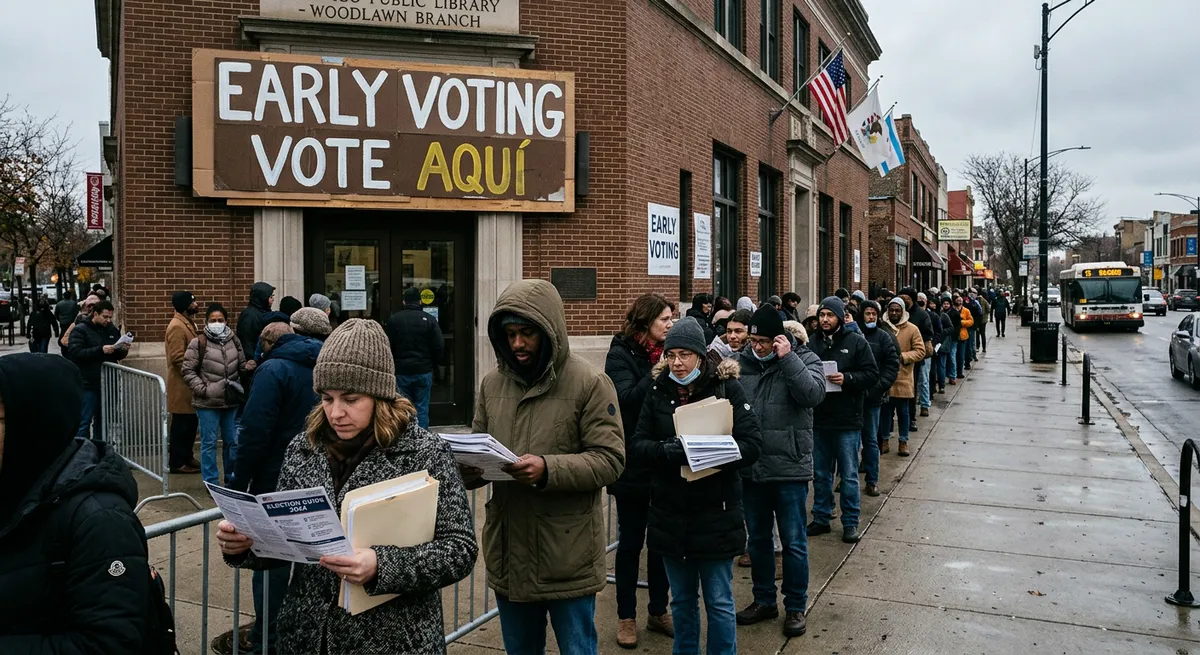
Early Voting Begins for March 17 Primary; City Clerk Releases 47-Page FAQ Clarifying What 'Early' Means
Early voting for the March 17 primary officially opened Monday in suburban Cook County and across all 50 Chicago wards, with the City Clerk’s office marking the occasion by releasing a 47-page Frequently Asked Questions document clarifying the definition of “early,” what activities constitute “voting,” and under what circumstances the combination of the two produces a legally valid ballot. The document, titled Early Voting: Understanding When You Are Voting and Whether That Vote Is Early, has been described by election officials as “comprehensive,” by civic organizations as “concerning,” and by at least one election judge at the 28th Ward site as “the longest thing I’ve ever tried to read while also helping people find parking.”
The FAQ opens with what the Clerk’s office describes as a “foundational clarification”: that early voting, despite its name, does not mean a voter is voting early in any subjective sense, but rather that the voter is voting during the Early Voting Period, which is a specific designated time window that is early only relative to Election Day itself and should not be confused with morning voting, first voting, or getting there before the rush. “We want voters to understand,” the document states in its second paragraph, “that there is no advantage to arriving early to early voting. Early voting is already early. You cannot be early to early.” This paragraph appears again, verbatim, on page 31, which the Clerk’s office says was intentional.
Questions 1 through 18 address variations on the theme of whether a ballot cast during early voting is the same as a ballot cast on Election Day. The answer, in each case, is yes. The document uses 14 different formulations of this answer, including: “Your ballot is a ballot,” “Early votes count as votes,” “Voting early does not make your vote early, it makes your vote cast,” and, in response to Question 11 (“But does it really count?”), simply: “Yes.” The Clerk’s office noted in a press statement that it had included multiple phrasings “in response to constituent feedback,” though it declined to specify what the feedback had said.
Questions 19 through 44 address ID requirements, registration status, and precinct boundaries, which election officials described as “the substance of the document” and which most observers agreed represented a reasonable and necessary civic resource. Questions 45 through 67, however, veer into territory that had political science faculty at Loyola calling one another to ask if they were seeing what they were seeing. Question 53 asks: “What if I vote early but then change my mind?” The answer is four paragraphs long, begins with the sentence “Illinois law does not currently recognize ballot regret as a legal category,” and ends with a reminder that the document is “for informational purposes only and does not constitute legal advice.” Question 61 asks: “What if I forget that I voted?” The answer is: “We recommend writing it down.”
Alderpersons across the city expressed a range of reactions. Several praised the document’s thoroughness. Ald. Diana Hernandez of the 24th Ward called it “an important resource for first-time voters and anyone who has questions,” and noted that her office had already fielded three calls from constituents asking whether early voting required a separate registration. (It does not. This is covered in Question 7, and again in Question 7(a), which is identical to Question 7 but in bold.) Ald. Ray Lopez of the 15th Ward said he had “not yet read all 47 pages” but called the effort “admirable.” When asked if he intended to read the remaining pages, he said he was “working on it.”
The document’s appendices, which run from page 38 to page 47, include a glossary of terms (“Vote (n.): An expression of preference cast by a registered voter during a designated voting period, whether early or otherwise”), a map of all 51 early voting sites in the city (the 51st, a pop-up site at the Harold Washington Library, was added after the document was already in layout and appears only in handwritten notation on a Post-It attached to page 39), and a two-page section titled “Common Misconceptions” that addresses the belief that early votes are counted before Election Day votes. They are not. This is also covered in Questions 4, 12, 14, 14(a), and the introduction.
Early voting runs through March 14. Election Day is March 17. A supplemental FAQ addressing questions about Election Day voting — “which,” the Clerk’s office noted in a statement, “is also voting, just not early” — is expected to be released by end of week and is anticipated to be significantly shorter, “in the 30 to 35 page range.”