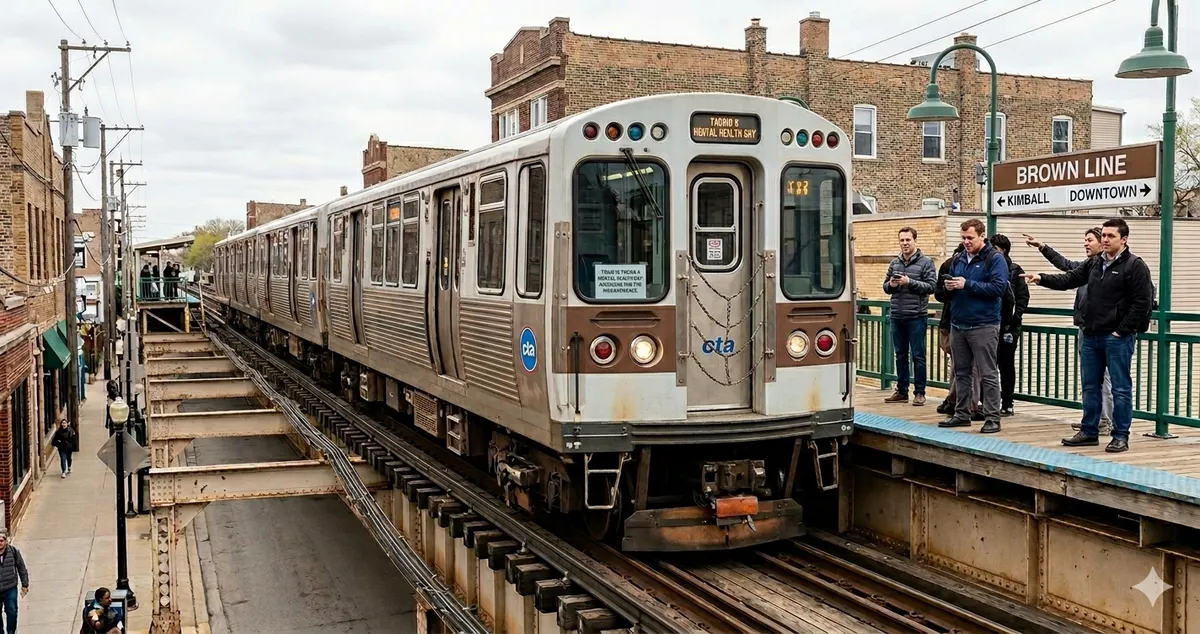
CTA Announces L Train Delays Now Caused by Trains 'Taking Mental Health Days'
Chicago commuters will need to find yet another reason to explain why they’re late to work, as the Chicago Transit Authority announced Thursday that recent L train delays are the result of trains “exercising their right to take mental health days.” The trains, it seems, have finally done what the rest of us only daydream about during our morning commute: they’ve set boundaries.
CTA President Dorval Carter Jr. held a press conference at the Clark/Lake station — which was itself delayed 45 minutes due to a Red Line car “experiencing an anxiety episode near Fullerton” — to explain the new policy. The station’s overhead lights flickered sympathetically throughout the briefing, as though they, too, had thoughts on the matter but were waiting for their turn in therapy.
“For decades, we’ve pushed these trains to their absolute limits,” Carter said, reading from a prepared statement while a Blue Line train audibly sobbed on an adjacent track, its windshield wipers going despite perfectly clear skies in what engineers have come to recognize as the mechanical equivalent of crying in the shower. “Six days a week, back and forth, through rain, snow, and the occasional mysterious liquid on the platform floor. It was only a matter of time before they started asking for boundaries.”
The policy change reportedly came after a Brown Line train refused to leave the Kimball yard one morning in February, with engineers discovering a handwritten note taped to the conductor’s cabin reading, “I just can’t today.” The note was written in what analysts later identified as brake fluid, which — if you’ve ever seen a train try to hold a pen — is actually quite impressive penmanship. A subsequent investigation by CTA’s newly formed Department of Locomotive Wellness found that nearly 73% of the fleet was operating at “critically low emotional bandwidth.” Several trains reportedly hadn’t experienced genuine joy since the last time someone made their connection without having to sprint.
Dr. Patricia Huang, a therapist who has been contracted to counsel the fleet, says the signs were there all along. “The unexplained breakdowns, the doors opening and closing for no reason — which, by the way, is textbook indecisiveness — the occasional refusal to move: these weren’t mechanical failures. These were cries for help,” she told reporters from her office inside a retrofitted rail car at the 54th/Cermak terminal. The car, she noted, had specifically requested soft lighting and a white noise machine, and had been making “really wonderful progress” since switching to decaf diesel.
Commuters have had mixed reactions. “I’ve been riding the Red Line for twelve years, and honestly, this explains a lot,” said Rogers Park resident Denise Kowalski, 34. “Last week my train just stopped between Sheridan and Addison for twenty minutes. The conductor said ‘mechanical difficulties,’ but you could tell that train was going through something. The way it just sat there, humming quietly to itself, staring out at the lake — that wasn’t a malfunction. That was a train having a moment.”
The CTA says it plans to roll out a comprehensive Employee — and now Vehicle — Assistance Program by summer, which will include meditation sessions at the Howard terminal, aromatherapy diffusers in all rail yards, and a “no-judgment zone” at the Loop elevated tracks where trains can simply exist without the pressure of adhering to a schedule. The third rail, which has quietly carried the emotional weight of the entire system for over a century, will reportedly be offered a sabbatical.